


On 6 April 2026, the Prototype Fast Breeder Reactor at Kalpakkam achieved first criticality. Seventy years after Homi Bhabha drew the blueprint, India has entered Stage II of its nuclear programme. The implications reach far beyond Tamil Nadu.
We have been covering India’s nuclear ambition and its plans regularly.
You can read past articles
https://theclimatedesk.substack.com/p/from-3-to-100-gw-indias-nuclear-leap
https://theclimatedesk.substack.com/p/the-monday-monocle-key-nuclear-energy
These will thread the lines leading up to the latest announcement we will be discussing here:

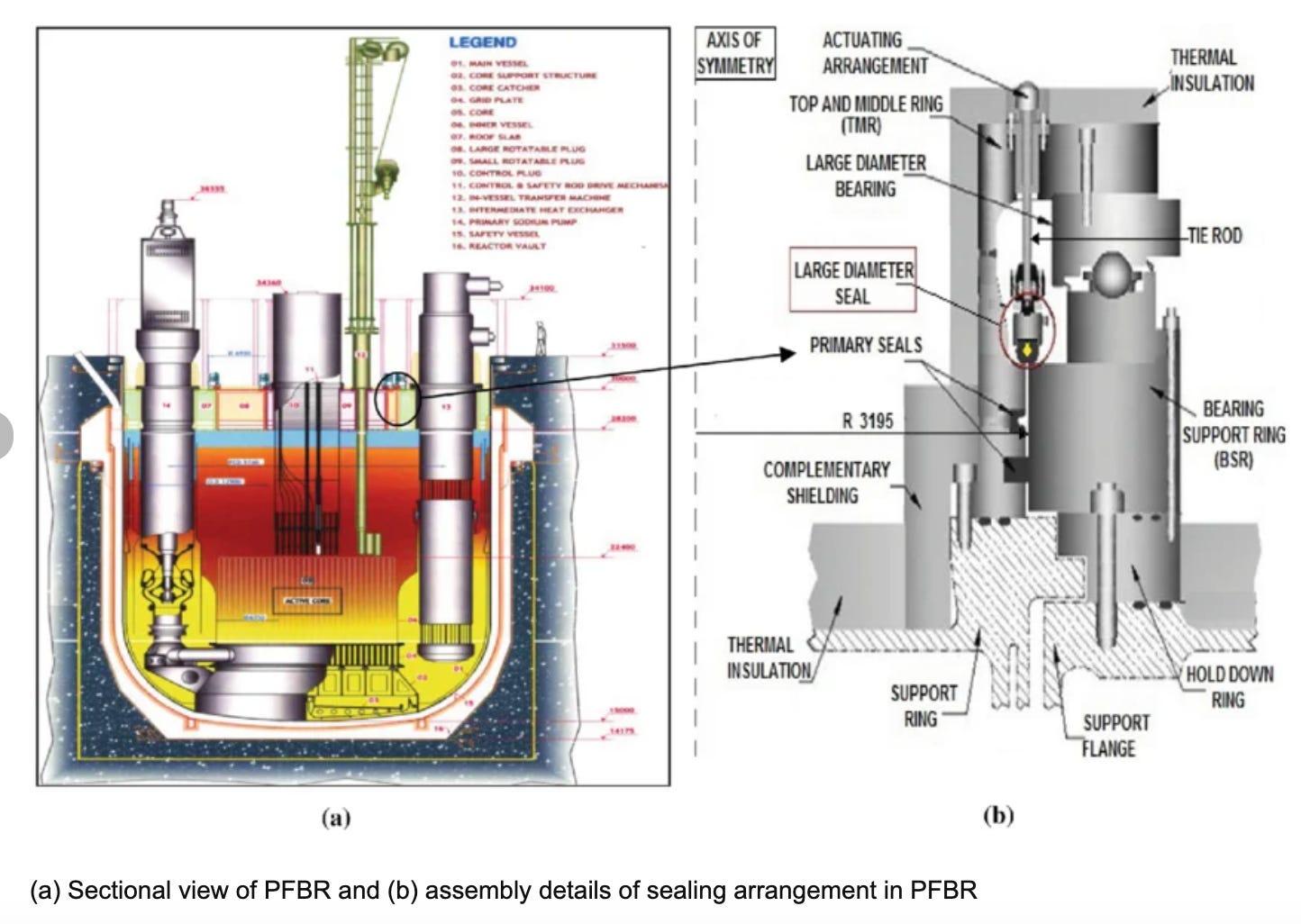
At 8:25 PM on 6 April 2026, a controlled fission chain reaction began inside a reactor at Kalpakkam, Tamil Nadu, and sustained itself without external input. India's Prototype Fast Breeder Reactor had reached criticality. The second stage of a nuclear programme conceived in the 1950s had switched on.
The Department of Atomic Energy made the announcement. Prime Minister Narendra Modi called it “a defining step in India’s civil nuclear journey,” noting that the reactor produces more nuclear fuel than it consumes. The PFBR was designed by the Indira Gandhi Centre for Atomic Research (IGCAR) and built by Bharatiya Nabhikiya Vidyut Nigam Limited (BHAVINI), both under the Department of Atomic Energy, after satisfying all conditions set by the Atomic Energy Regulatory Board (AERB).
This is an architectural shift: in fuel cycle strategy, in energy sovereignty, in industrial capability, and in India’s position within the global nuclear order.
01 What Happened
First Criticality: What It Means
Criticality is the state in which a fission chain reaction becomes self-sustaining. Each fission event produces exactly enough neutrons to trigger subsequent reactions at a steady rate, without external input. It is the threshold a reactor must cross before it can be scaled to full power and connected to the grid.
Criticality achieved on 6 April 2026 does not mean the PFBR is generating electricity. It means the reactor is confirmed to be functioning as designed. Staged power ascension, testing, and safety validation follow before grid connection. Commercial operations, generating 500 MWe, are targeted for September 2026, pending further AERB approval.
Fuel loading had commenced on 18 October 2025 after AERB granted permission for the first approach to criticality. Construction of the PFBR began in 2004 with an original target of 2010, a delay of 16 years that reflects the genuine difficulty of first-of-kind nuclear engineering at commercial scale. The project cost rose from an original estimate of Rs. 3,500 crore to approximately Rs. 7,700 crore over its development cycle.
02 The Technology
How a Fast Breeder Reactor Works
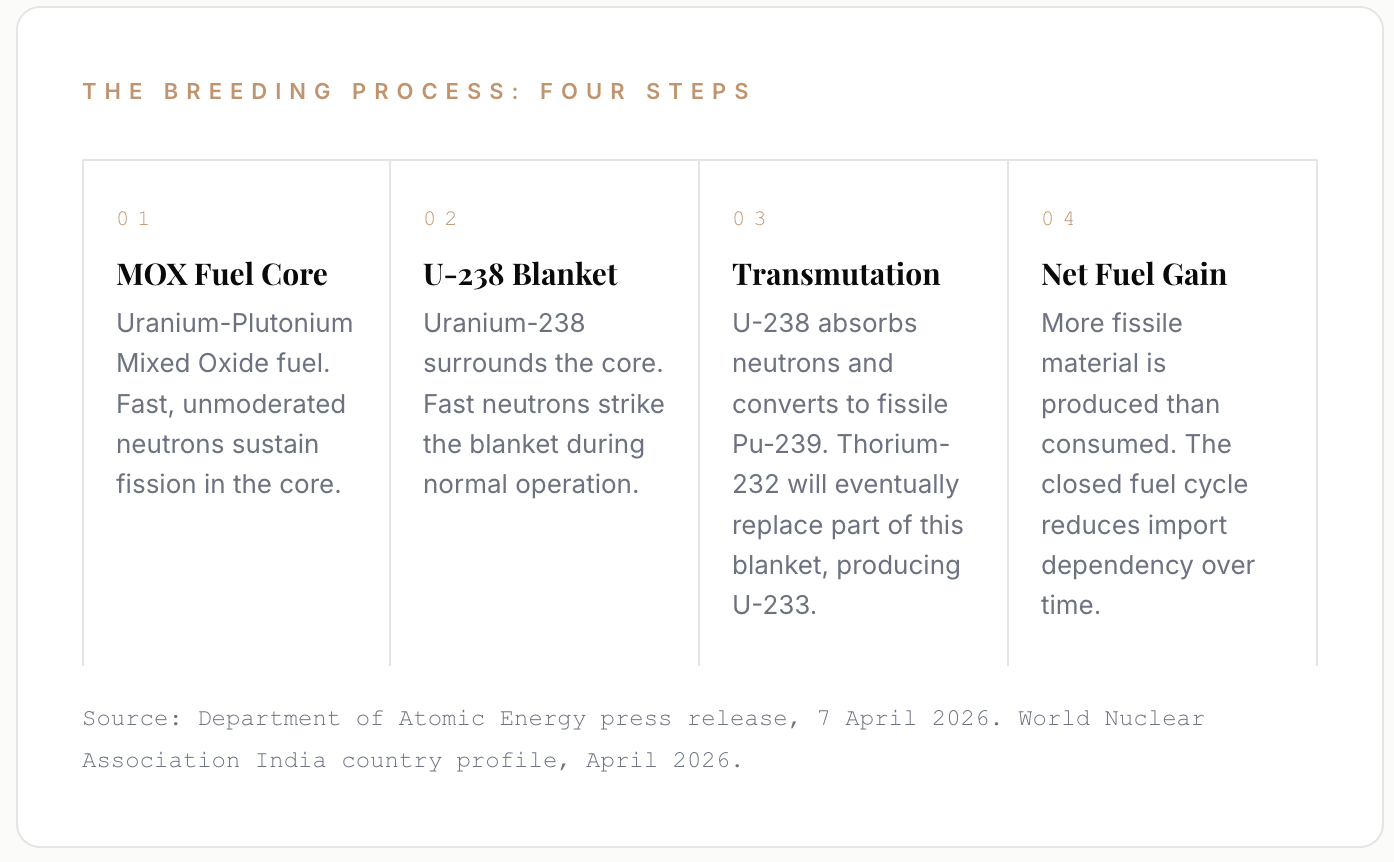
The PFBR operates on principles that are categorically different from every conventional reactor India has run before. A standard Pressurised Heavy Water Reactor (PHWR) uses uranium-235 as its fissile fuel: uranium-235 constitutes only 0.7 percent of naturally occurring uranium. India holds only 1-2 percent of global uranium reserves and currently imports over 70 percent of its nuclear fuel requirements
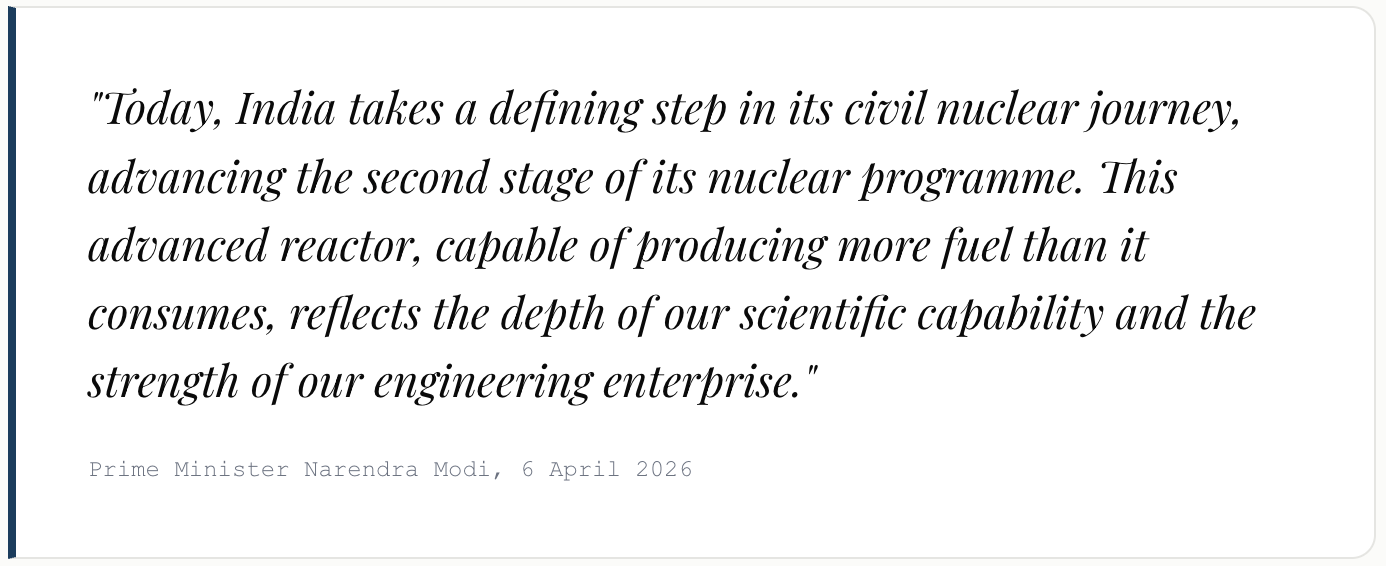
The reactor uses 1,750 tonnes of liquid sodium as coolant. Sodium does not slow down fast neutrons, making it ideal for this design. A dedicated Fast Reactor Fuel Cycle Facility (FRFCF) is currently under construction at Kalpakkam to support reprocessing and closed-cycle refuelling for the PFBR and future fast breeder reactors.
03 The Strategic Context
Bhabha’s 70-Year Plan: The Three-Stage Programme
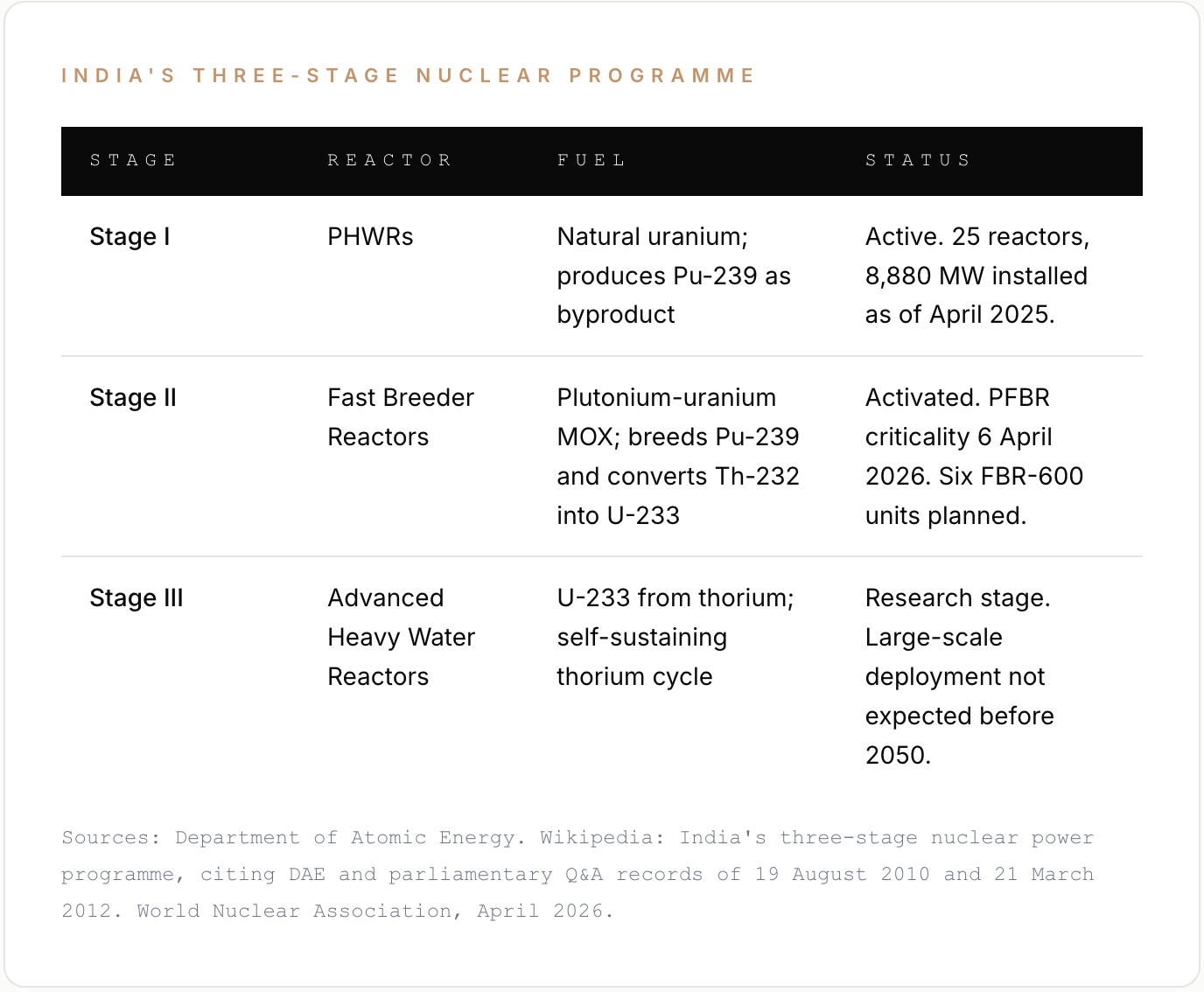
The PFBR is not a standalone reactor. It is the second stage of a three-stage nuclear power programme conceived by Dr. Homi Bhabha in the 1950s and designed around one resource reality: India has very little uranium and very large thorium reserves. India holds an estimated 25 percent of global thorium deposits, concentrated in the monazite sands of Kerala and Odisha, but thorium cannot directly fuel a reactor. It requires transmutation into uranium-233 inside a fast breeder. The PFBR performs that transmutation. Without Stage II operational, Stage III is unreachable.
04 Energy Resilience
What This Changes for India’s Energy Mix
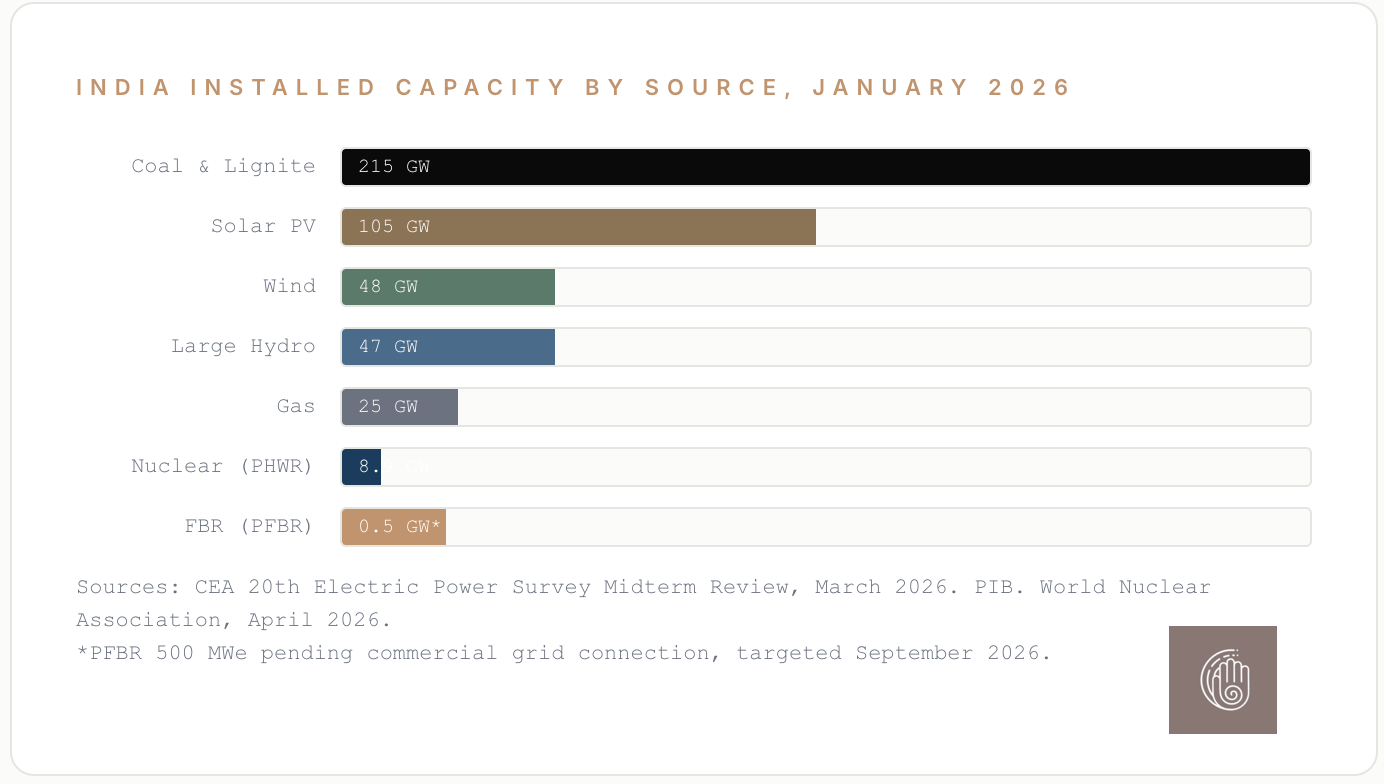
India’s installed electricity capacity stood at approximately 520 GW as of January 2026, per the Central Electricity Authority’s 20th Electric Power Survey midterm review (March 2026). Coal and lignite account for around 215 GW: over 40 percent of installed capacity and close to 50-60 percent of actual electricity generated. Solar has grown rapidly to over 100 GW. Nuclear, across 25 reactors, contributes 8,880 MW: approximately 3 percent of generation.
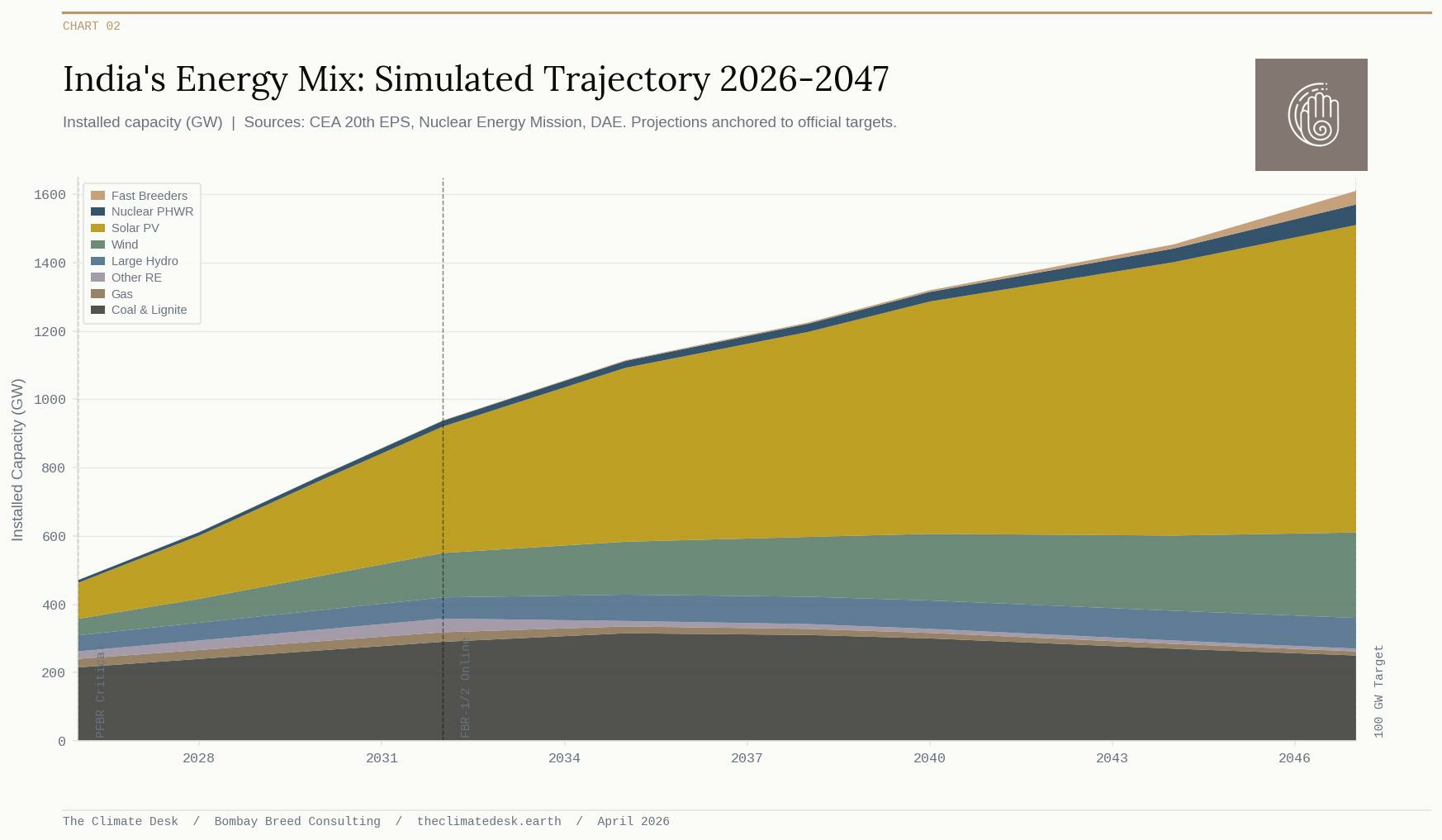
(to read the interactive map of how India’s energy mix changes with time, visit this link:
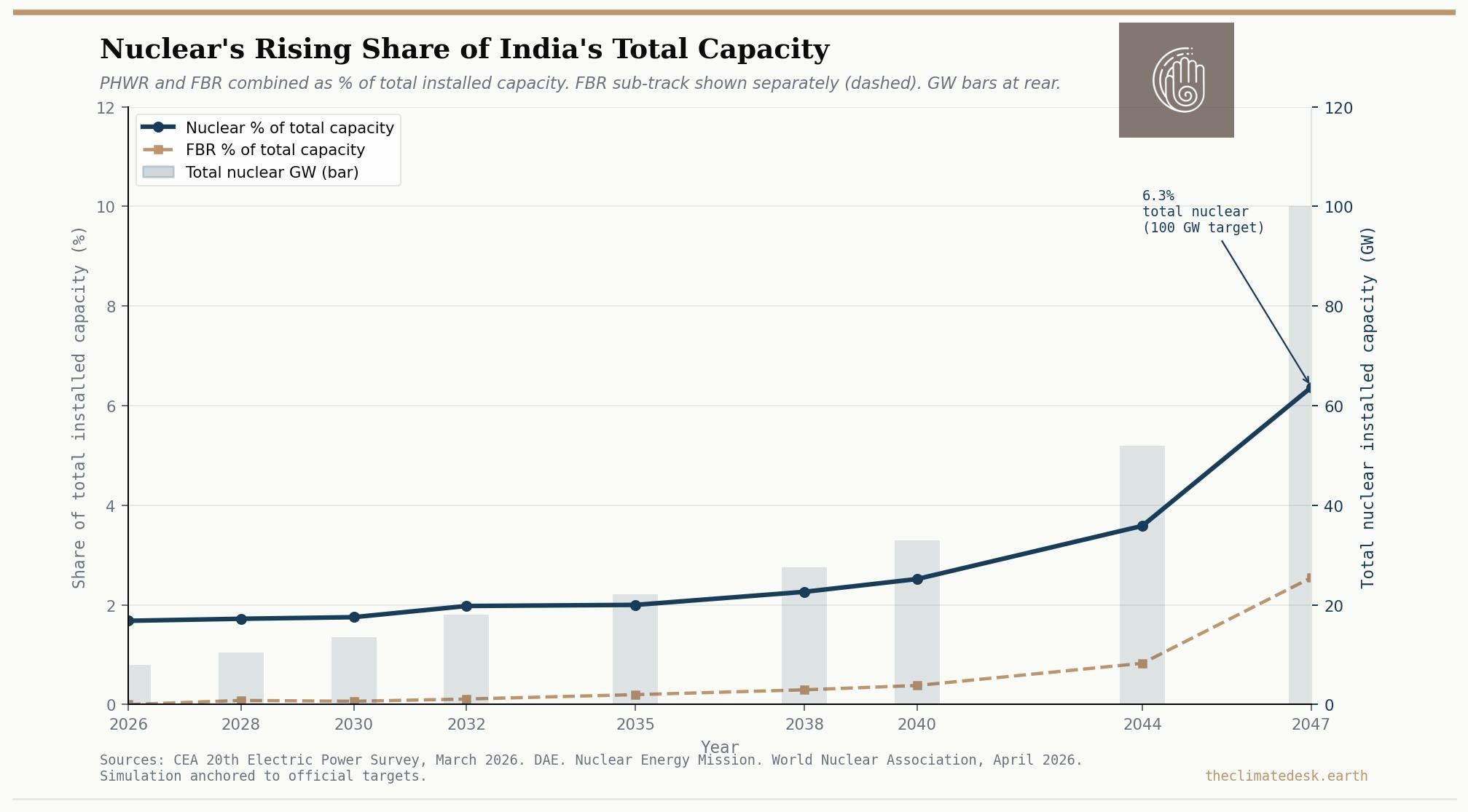
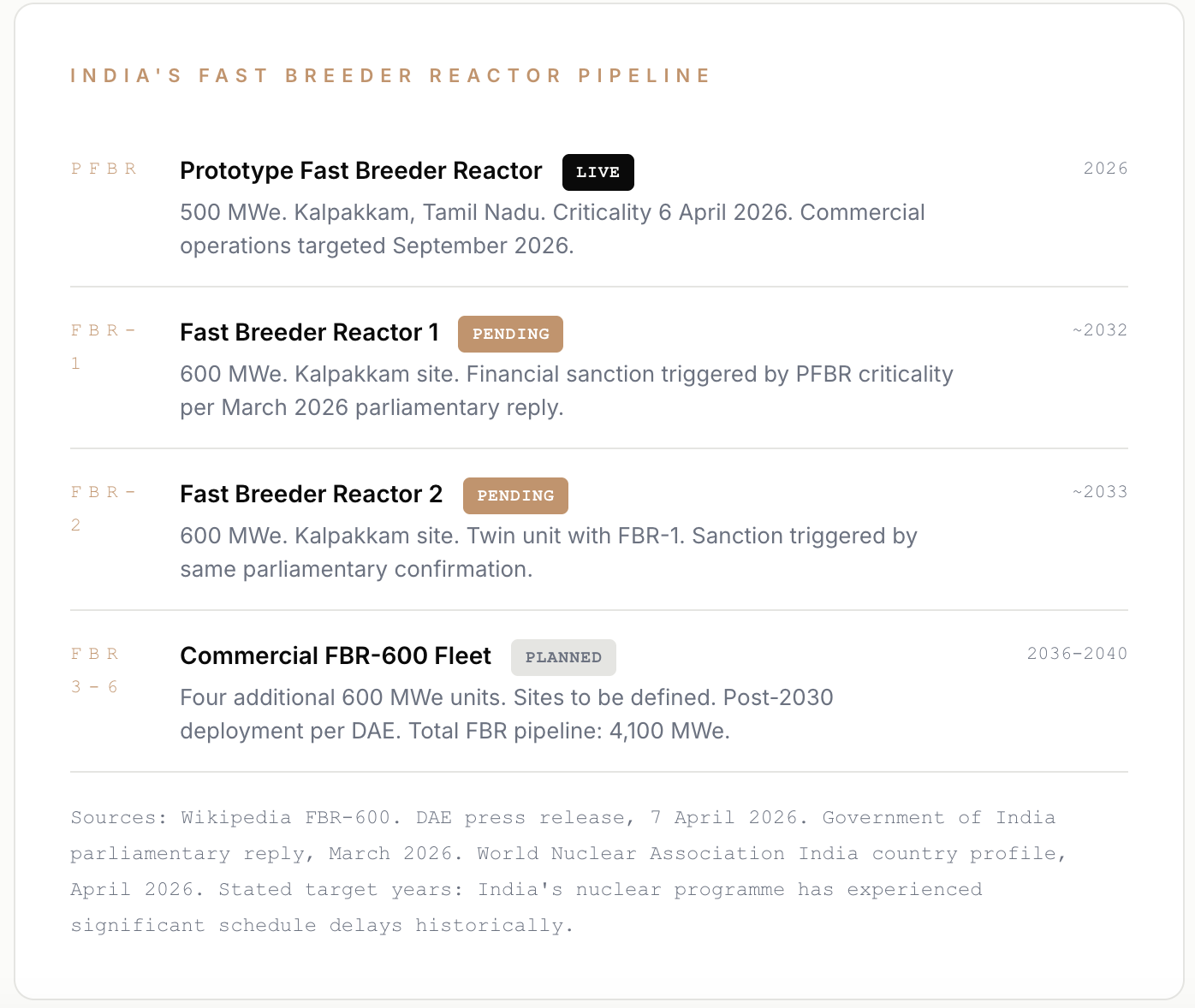
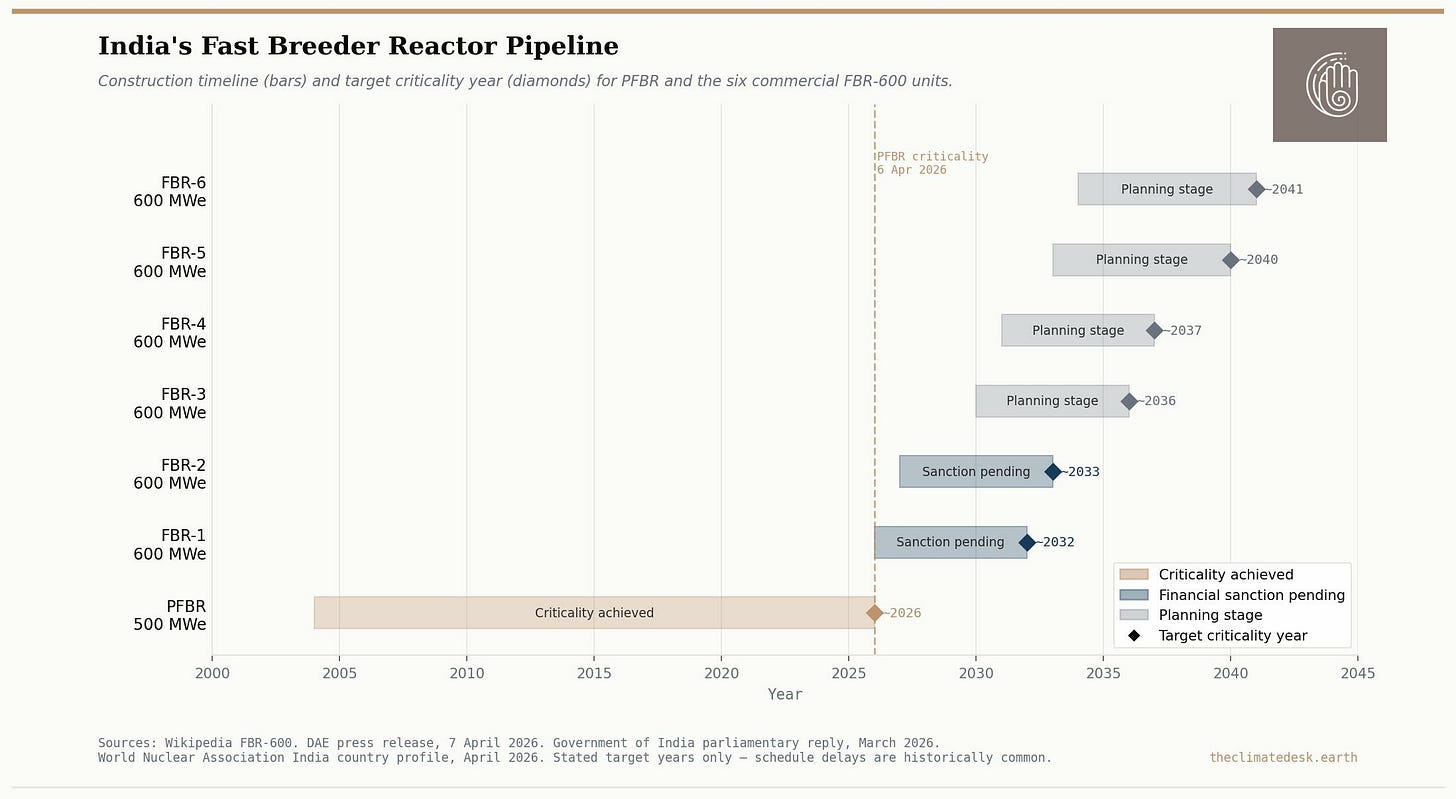
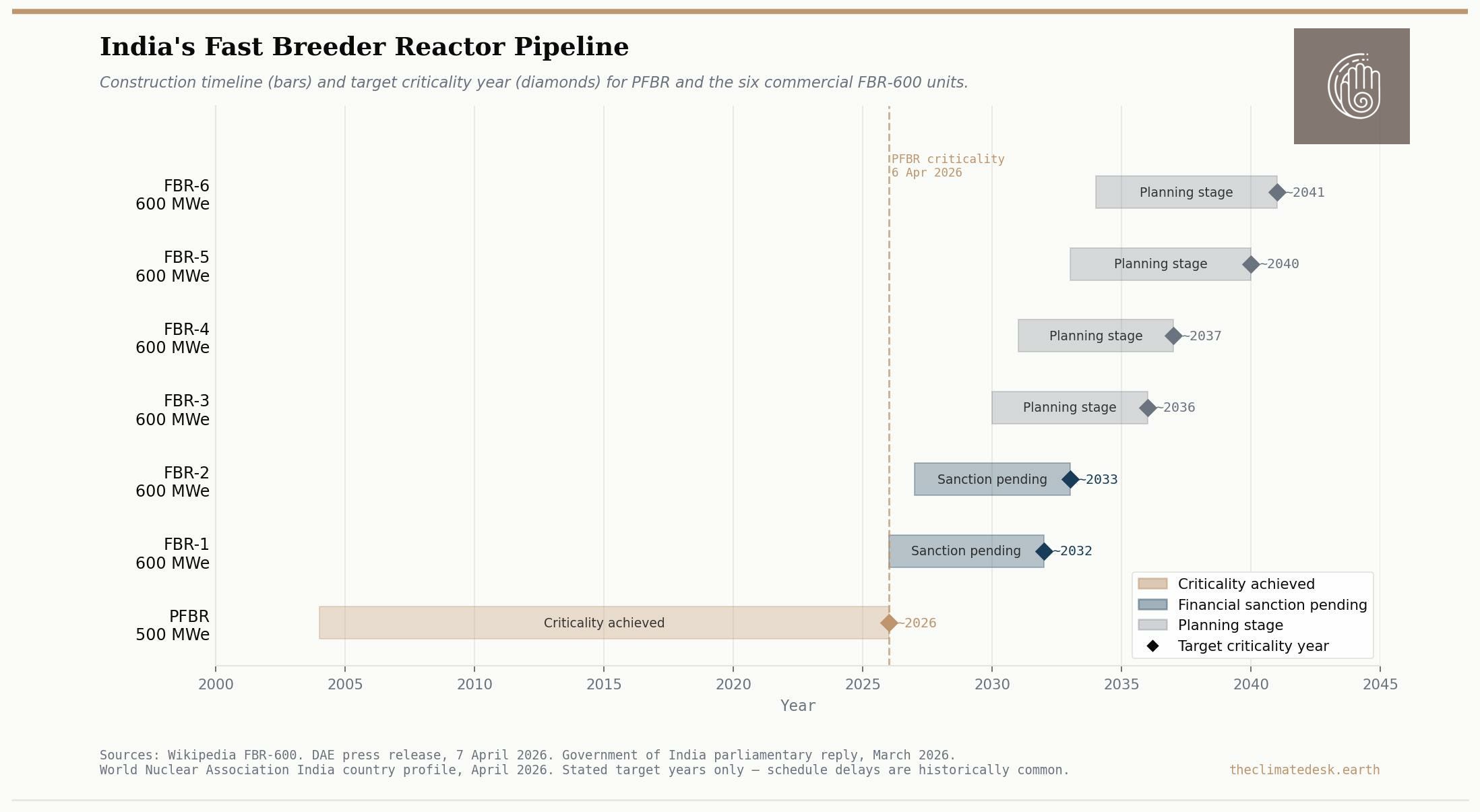
The PFBR adds 500 MWe to that nuclear base: modest in isolation, consequential as a trigger. A March 2026 parliamentary reply confirmed that achieving PFBR criticality would prompt financial sanction for the twin FBR-1 and FBR-2 projects at Kalpakkam, each rated at 600 MWe. The commercial FBR pipeline of six reactors at 600 MWe each represents a total of 3,600 MWe from the IGCAR-designed FBR-600 class. India’s Nuclear Energy Mission targets 22 GW of nuclear capacity by 2031-32 and 100 GW by 2047.
A note on cost: nuclear electricity in India is more expensive per unit than solar, with multiple independent analyses placing the levelised cost of nuclear at two to three times that of solar (Climate Scorecard, citing CAG 2022 and CEA 2023). The economic case for nuclear rests on baseload reliability and fuel sovereignty, not on marginal cost. Solar and nuclear serve different grid functions. Both are necessary. They are not in competition.
05 The Pipeline
More Reactors Using the Same Technology
The PFBR is explicitly a prototype. The commercial programme it unlocks is the FBR-600 class: six reactors designed by IGCAR at 600 MWe each, co-located in pairs to share infrastructure and rationalise cost. Running in parallel, the Nuclear Energy Mission funds five Bharat Small Modular Reactors (BSMR-200) by 2033 for industrial decarbonisation, and the NPCIL-NTPC joint venture ASHVINI is building four 700 MWe PHWRs at Mahi-Banswara, Rajasthan.
What India Can Now Offer, and to Whom
The Kalpakkam criticality, read alongside the SHANTI Bill (Atomic Energy Bill 2025, approved by Cabinet December 2025 and permitting private and foreign participation in India’s civil nuclear sector for the first time), constitutes the most significant restructuring of India’s nuclear sector since the 1962 Atomic Energy Act. Three technology tracks are now available for export or partnership, each at a different level of commercial readiness.
The strategic demand map for Indian nuclear technology follows the same logic India itself operates under: countries with large thorium reserves and limited uranium access face an identical structural constraint. Brazil, Australia, Norway, and Turkey all hold significant thorium deposits. Countries in South and Southeast Asia building first nuclear capacity need reactor designs scaled to smaller grids, with technology transfer built in.
India’s existing template is instructive. Its contribution to Bangladesh’s Rooppur Nuclear Power Plant, alongside Russia’s Rosatom, included capacity building, knowledge transfer, and training of Bangladeshi nuclear engineers. The Indian Council of World Affairs (a Government of India think tank) has outlined this as a model for what it terms “thorium diplomacy”: using nuclear knowledge-sharing as soft power, with the FBR and thorium cycle as the long-term centrepiece.
The US-India nuclear relationship is also evolving. In August 2025, the United States granted an export licence to Chicago-based Clean Core Thorium Energy to supply its advanced HALEU-thorium fuel technology to India’s PHWR fleet: only the second such US nuclear export licence to India in nearly two decades. This bilateral technology flow signals that the non-proliferation architecture around India-specific nuclear cooperation is maturing, a prerequisite for India to eventually export its own technology outward through IAEA-governed civil nuclear agreements.
06 Risks: A Fair Assessment
What Could Go Wrong
01
Execution track record
The PFBR was originally due in 2010. It achieved criticality in 2026. The 100 GW by 2047 goal requires a pace of delivery that has not been demonstrated. The interim 22 GW by 2031-32 target is considered ambitious by independent analysts.
02
Electricity cost relative to renewables
PFBR electricity will cost substantially more per unit than solar. Climate Scorecard, citing CAG 2022 and CEA 2023, estimates nuclear levelised cost at two to three times solar LCOE in India. The economic case for nuclear rests on baseload reliability and fuel sovereignty, not cost competition.
03
Sodium coolant risk
Liquid sodium burns in air and reacts violently with water. Japan’s Monju reactor suffered a sodium leak in 1995 that contributed to its eventual shutdown in 2016. This is a manageable engineering challenge with inherent passive safety features designed into the PFBR, but it requires sustained operational discipline across decades of operation.
04
Thorium timeline
Full Stage III deployment is not expected before 2050 per Indian parliamentary records. The doubling time for fissile material in fast breeders was revised from Bhabha’s original 5-6 year estimate to approximately 70 years, due to technical realities unforeseen in the 1950s. Large-scale thorium utilisation remains a long horizon.
05
Export readiness gap
The AHWR export design was announced in 2009. The World Nuclear Association notes that “little has happened on this front since then.” The gap between announced design and commercial delivery has been a consistent pattern in India’s nuclear sector. Speed of scale execution needs a re-look.
06
Grid and transmission infrastructure
A 100 GW nuclear fleet requires commensurate transmission infrastructure, grid management systems, and demand planning that must be developed in parallel. The Central Electricity Authority projects total investment requirements in India’s power sector at approximately $2.2 trillion over the next two decades.
07 The Bottom Line
What Kalpakkam 2026 Signals
On 6 April 2026, India proved it can build and operate a fast breeder reactor: indigenously designed, indigenously built, using a closed fuel cycle that produces more fissile material than it consumes. That proof has been 70 years in the making.
For India’s energy mix, the PFBR begins a structural shift from import-dependent uranium toward a domestically grounded closed fuel cycle, with thorium as the eventual terminal fuel. That shift will take decades to fully materialise. The Kalpakkam criticality is the moment it became technically confirmed.
For the commercial pipeline: FBR-1 and FBR-2 financial sanctions are now unlocked. Six commercial FBR-600 reactors follow across the 2030s and 2040s. The SMR programme runs in parallel. India’s nuclear construction programme is the most active it has ever been, and the SHANTI Bill has opened it to private capital for the first time in over six decades.
For the region: India is the second country in the world with an operational commercial fast breeder programme. The institutional knowledge in IGCAR and BHAVINI, the supply chain across more than 200 Indian industries, and the three-stage fuel cycle architecture are strategic assets that countries with large thorium deposits, limited uranium access, and growing baseload demand will find increasingly relevant across the decade ahead.
Phantastic! Almost too good to be true at this stage.
As a Swiss non-specialist my question, of course, and financial feasibility apart, is whether this different fast breeder technology is region-specific or potentially interesting for all countries with access to Thorium.
First criticality is the moment the chain reaction holds. The distance between that and commercial power output is where the real infrastructure story sits — fuel fabrication, sodium coolant systems, grid interconnect approvals, and a liability framework that still hasn't resolved who backstops a sodium-cooled incident. The 70-year queue was about politics. The next 10 years are about maintenance regimes and procurement pipes.